

Can You Bring a Shaving Razor on a Plane? TSA Rules Explained


Yes, most shaving razors can fly, but the answer depends on the blade. Under TSA rules, disposable razors, cartridge razors, and electric shavers are allowed in both carry-on and checked bags. Loose blades, safety razors with a blade installed, and straight razors are not allowed in the cabin and have to travel in checked luggage.
The TSA rules are the baseline for airports in the United States, while the UK, the EU, and Canada apply their own lists with similar logic and a few important differences. At any checkpoint, the security officer makes the final call. The sections below cover each razor type, the shaving products that usually share the same toiletry bag, international exceptions, and a checklist for packing the night before a flight.
Quick Answer to Razor Rules for Carry-On and Checked Bags
What matters is whether the blade is enclosed and fixed or removable and exposed. TSA treats a blade sealed inside a plastic cartridge as a normal toiletry. A blade that can be taken out and held on its own is a sharp object, and sharp objects stay out of the cabin.
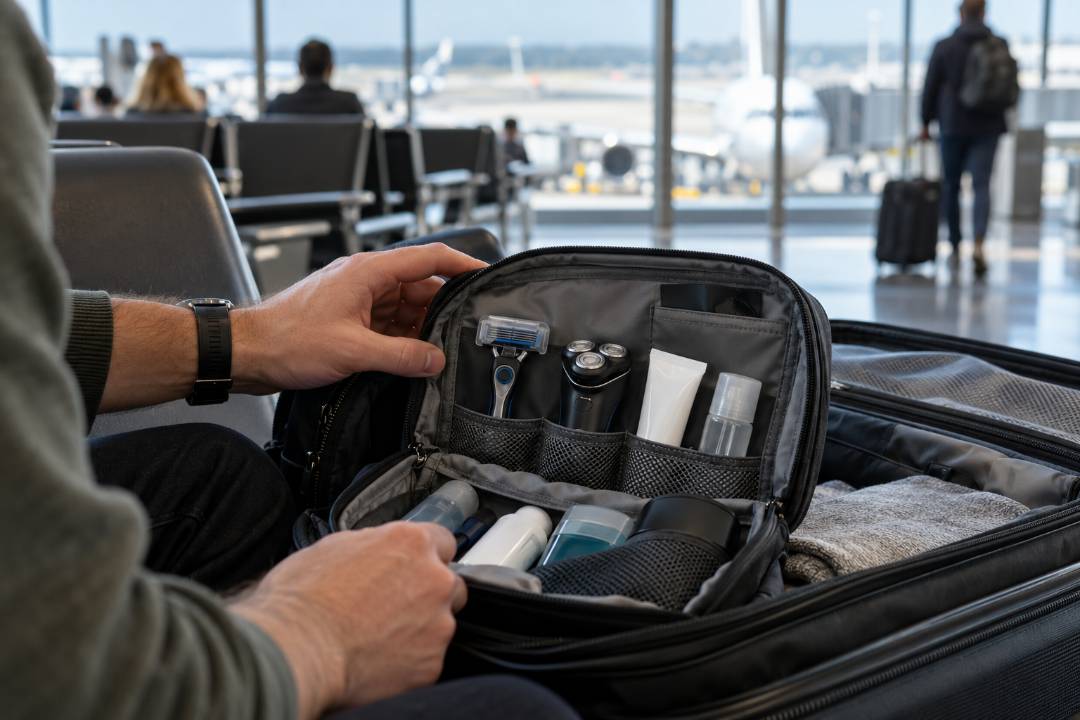
In practice, the carry-on side of the list is long. Disposable razors, cartridge razors, replacement cartridge heads, electric shavers, beard trimmers, and hair clippers can all go in a cabin bag. The checked-only side includes double-edge and single-edge safety razor blades, any loose razor blade, straight razors, and barber-style razors with an open edge.
Shaving products follow a different rule. Shaving cream, gel, foam, and aftershave are restricted because they count as liquids, aerosols, or gels, and sharpness has nothing to do with it. In a carry-on bag, each container has to be 3.4 oz (100 ml) or smaller.
Razor Rules at a Glance by Item
The table below sorts common razors and grooming items by where they can travel on a flight departing from a U.S. airport. “Checked only” means the item is fine in the hold but will be stopped at the security checkpoint.
| Item | Allowed in Carry-On | Checked Baggage Only | Not Allowed at All | Packing Note |
|---|---|---|---|---|
| Disposable razor | Yes | No | No | Keep the plastic cap on |
| Cartridge razor | Yes | No | No | Leave the cartridge attached and covered |
| Replacement cartridges | Yes | No | No | Keep them in the original packaging |
| Safety razor handle, no blade | Yes | No | No | Remove the blade at home, not at the checkpoint |
| Safety razor with blade installed | No | Yes | No | Take the blade out or check the whole razor |
| Double-edge or single-edge blades | No | Yes | No | Keep blades in their paper sleeves or a blade case |
| Loose razor blades | No | Yes | No | Wrap them so they cannot cut through the bag |
| Straight razor | No | Yes | No | Fold it closed and use a sheath |
| Electric razor or shaver | Yes | No | No | Lock the switch or use a cap |
| Beard trimmer or hair clippers | Yes | No | No | Attach the blade guard |
| Shaving cream, gel, or foam | Up to 3.4 oz (100 ml) | Larger sizes | No | Put carry-on sizes in the liquids bag |
| Aftershave, balm, or cologne | Up to 3.4 oz (100 ml) | Larger sizes | No | Seal the cap inside a zip bag |
| Solid shaving soap | Yes | No | No | Store it dry in a small case |
| Small scissors | Blades under 4 inches from the pivot | Longer blades | No | Measure from the pivot point |
| Spare lithium battery | Yes | No | Not in checked bags | Keep it in carry-on only |
None of the razors in this table is banned from a plane completely. The restrictions are about location: sharp, removable, or exposed blades belong in the hold, while enclosed blades and electric devices can stay with the traveler.
TSA Rules by Razor Type
TSA sorts razors by how easy it is to separate the blade. Enclosed blades count as low risk and can go through the checkpoint. Removable or exposed blades fall under the same category as box cutters and knives, so they are allowed only in checked baggage, wrapped or sheathed to protect baggage handlers and inspectors.
Disposable and Cartridge Razors
Disposable razors and cartridge razors are allowed in both carry-on and checked bags because their blades are fixed inside the razor head. This covers the typical supermarket razor, a multi-blade handle with a snap-on cartridge, and a pack of replacement cartridge heads. TSA applies its blade restriction only to razor blades that are not in a cartridge.
These razors are the easiest choice for a carry-on-only trip, a weekend city break, or a business trip without checked luggage. A plastic cap or blade guard is not required by TSA, but it protects the edge and stops the blades from cutting a toiletry bag or a finger during a quick search for a toothbrush.
Safety Razors, Loose Blades, and Straight Razors
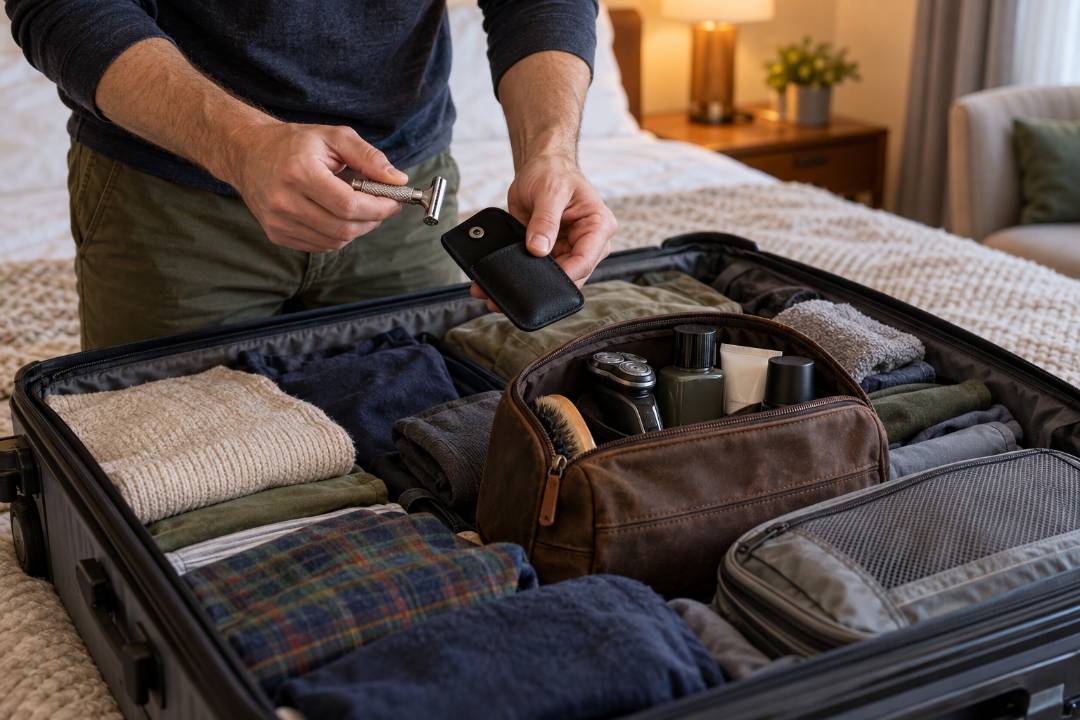
A safety razor is allowed through the checkpoint only without its blade. TSA states that the blade must be removed before entering the checkpoint and that officers are not authorized to remove it for the passenger. The empty handle can stay in the cabin bag, while the blades travel in checked luggage in their original sleeves, a blade case, or another rigid container.
Double-edge blades, single-edge blades, and other loose razor blades are prohibited in carry-on bags and allowed in checked bags. The same rule applies to straight razors and barber razors, which have an exposed edge by design. A blade left in a safety razor by mistake is enough to get a shaving kit pulled for a second look at screening.
Travelers who shave with a safety razor or a straight razor often end up checking a suitcase just for the blades. That bag can become a burden after landing at John F. Kennedy International Airport in the morning when the hotel does not allow check-in until the afternoon. A luggage storage service like Qeepl helps find a verified storage spot near airports, stations, and city centers from US$4.90 per bag per day, so the first hours in a new city can go to breakfast, a museum, or a walk instead of dragging a suitcase around.
Shaving Cream, Electric Shavers, and Related Grooming Items
A razor rarely travels alone. The same toiletry kit usually holds shaving cream, aftershave, a trimmer, and sometimes spare batteries, and each of these items is restricted for a different reason than the blade itself.
Shaving Cream, Gel, Foam, Aftershave, and Balm
In carry-on bags, shaving products fall under the TSA 3-1-1 rule for liquids, aerosols, gels, creams, and pastes. Each container can hold up to 3.4 oz (100 ml), and all of them have to fit into one quart-size clear bag per passenger. TSA specifically lists aerosol shaving cream as allowed in the cabin within that limit and allowed in checked bags in larger sizes.
Larger bottles of aftershave, balm, lotion, or cologne should go in checked luggage. Aerosols in the hold have their own limits: the FAA allows toiletry aerosols up to 500 ml (17 fl oz) per container and 2 kg or 2 liters in total per person, with the nozzle protected by a cap. Solid shaving soap, shaving sticks, and soap pucks are not liquids, which makes them the easiest option for a carry-on-only bag.
Electric Razors, Trimmers, Batteries, and Accessories
Electric razors, electric shavers, beard trimmers, body groomers, and hair clippers are allowed in both carry-on and checked bags. Packing an expensive device in the cabin bag reduces the risk of damage or loss. Devices with installed lithium batteries can go in checked luggage only if they are switched completely off and protected from accidental activation.
Spare lithium batteries and power banks are a different category. The FAA allows them only in carry-on bags, with terminals covered or each battery in a separate pouch. If a cabin bag is gate-checked because the overhead bins are full, spare batteries have to come out of the bag and stay with the passenger. A travel lock, a cap over the cutting head, or a hard case keeps a trimmer from switching on under pressure inside a packed bag.
International Flights and Airport Security Differences
TSA rules apply at U.S. airports such as Los Angeles International Airport, but they are not a global standard. Every departure and every transfer with a new security check follows local rules. A return trip through Heathrow, Paris Charles de Gaulle, or Toronto Pearson can involve a different list than the outbound flight.
Most systems share the same core split between enclosed and loose blades. UK government guidance allows disposable razors with fixed cartridges in hand luggage and electric shavers in both hand and hold luggage. EU rules prohibit open razors and loose blades in the cabin, with an exception for safety or disposable razors whose blades are enclosed in a cartridge. Transport Canada lists items with razor blades, including safety razors, as not allowed in the cabin, while disposable razors are allowed.
The details differ more for scissors and liquids. TSA allows scissors with blades under 4 inches from the pivot, while the UK, the EU, and Canada use a 6 cm limit. Some UK airports with new scanners accept larger liquid containers, while others still apply the 100 ml rule, depending on the equipment at each checkpoint. For a trip with connections, the strictest airport on the route sets the rules, and the official airport or government security page is the most reliable place to check before flying.
Practical Packing Checklist for Traveling With a Razor
A few minutes of sorting the night before a flight prevents most problems at the checkpoint. The list below works for trips departing from the U.S. and for most international itineraries:
- Identify the razor type before packing: disposable, cartridge, safety, straight, or electric.
- For carry-on-only travel, choose a disposable razor, a cartridge razor, or an electric shaver.
- Remove the blade from a safety razor at home, because TSA officers will not take it out at screening.
- Place double-edge, single-edge, and other loose blades only in checked baggage, inside their sleeves or a blade case.
- Fold a straight razor closed, put it in a sheath, and pack it in the checked bag.
- Keep shaving cream, gel, foam, aftershave, and balm in containers of 3.4 oz (100 ml) or less inside the liquids bag.
- Cap aerosol nozzles and seal liquid bottles in a zip bag to prevent leaks.
- Switch electric shavers and trimmers fully off and lock the power button or use a cap.
- Keep spare lithium batteries and power banks in the carry-on bag, and take them out if the bag is gate-checked.
- Check the official rules for every departure and transfer airport on an international route.
- Buy replacement blades after arrival if the trip does not include a checked bag.
- Keep the toiletry kit easy to reach, since the officer at the checkpoint has the final decision on any item.
