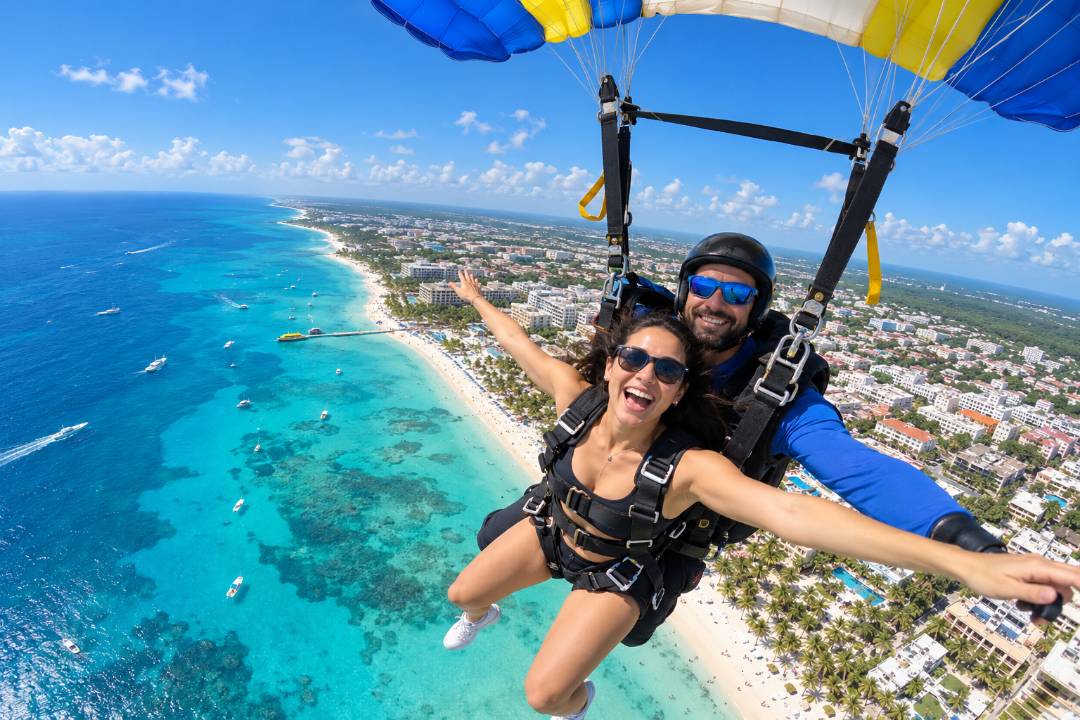

Jumping out of a small plane at over 4,000 meters, falling at about 200 km/h and landing next to a lake or on the sand of the Caribbean is no longer reserved for extreme athletes. Mexico has several skydiving centers that offer tandem jumps for beginners, most of them a few hours from Mexico City Airport or in beach destinations such as the Riviera Maya and the Oaxaca coast. You jump strapped to a certified instructor, with no previous experience, after about 20 minutes of ground training.
This guide covers the best places to go skydiving in Mexico, with altitudes, seconds of freefall and the prices published by the centers themselves. It also explains what a tandem jump looks like step by step, what the requirements are, the best season to jump and what to check when choosing a safe center.
The Best Places to Go Skydiving in Mexico
Mexico’s skydiving map has two main hubs. The first is in the center of the country, in Morelos and Puebla, where the dry climate for much of the year and the airfields close to the capital make it possible to jump almost every day. The second is on the coast, with jumps over the Caribbean Sea and the Pacific that end with a beach landing. There are also drop zones in Querétaro, Monterrey, Ixtapa-Zihuatanejo, Puerto Vallarta and Baja California, although with fewer options for tourists.
Tequesquitengo, Cuautla and Atlixco Near Mexico City
Tequesquitengo, in Morelos, is the best-known name in Mexican skydiving. It is home to Skydive México, a center specializing in tandem jumps with views of Lake Tequesquitengo. It offers four altitudes with different freefall times: 30 seconds from 13,000 feet, 45 seconds from 15,000 feet, 60 seconds from 17,000 feet and 90 seconds from 21,000 feet, the last one with supplemental oxygen. Published prices range from $2,490 to $5,490 MXN, as a promotional rate when paying in cash. For anyone coming from the capital or from Cuernavaca, Tequesquitengo works as a day trip.
In Cuautla, also in Morelos, the main jump is made from 17,000 feet above sea level, with about 60 seconds of freefall at 200 km/h, and there is a shorter version called the T-jump from 13,000 feet. In Atlixco, Puebla, the Skydive Puebla center jumps from the local airfield and publishes early booking rates of $3,550 MXN for 17,000 feet and $3,050 MXN for 15,000 feet. Buses to Puebla leave from, among others, the TAPO terminal in Mexico City, and Atlixco is a short drive from the city of Puebla.
Playa del Carmen and Puerto Escondido Over the Sea
In the Riviera Maya, the most popular jump is in Playa del Carmen. The plane takes off from the city’s airfield and makes a scenic flight of about 15 minutes over Playa del Carmen or Cozumel, and the jump is made from 10,000-13,000 feet, with about 40 seconds of freefall and 5-7 minutes under the parachute. You land on the sand, facing the Caribbean Sea. Many travelers arrive at Cancún Airport and book the jump for a free day in Playa del Carmen.
On the Oaxaca coast, the Skydive Puerto Escondido center in Puerto Escondido offers tandem jumps from 13,000 feet above sea level with a landing on Zicatela beach, famous among surfers, where the landing area is more than 1,000 meters long. The published price is $3,800 MXN, with a $1,000 MXN deposit when booking and the rest paid at the drop zone.
| Location | Center | Jump Altitude | Freefall | Published Price |
|---|---|---|---|---|
| Tequesquitengo, Morelos | Skydive México | 13,000-21,000 feet | 30-90 seconds | $2,490-$5,490 MXN |
| Cuautla, Morelos | Skydive Cuautla | 13,000-17,000 feet | Up to 60 seconds | Ask the center |
| Atlixco, Puebla | Skydive Puebla | 15,000-17,000 feet | Depends on altitude | $3,050-$3,550 MXN |
| Playa del Carmen, Quintana Roo | Skydivemex | 10,000-13,000 feet | About 40 seconds | Ask the center |
| Puerto Escondido, Oaxaca | Skydive Puerto Escondido | 13,000 feet | Depends on altitude | $3,800 MXN |
Prices are the rates published on each center’s website in 2026 and may change depending on the season, payment method or promotions.
What a Tandem Jump Looks Like Step by Step
A tandem jump is the most common way to skydive for the first time. You are attached by a double harness to a certified instructor, who handles the exit from the plane, stability during the fall, opening the parachute and the landing. No previous course is needed.
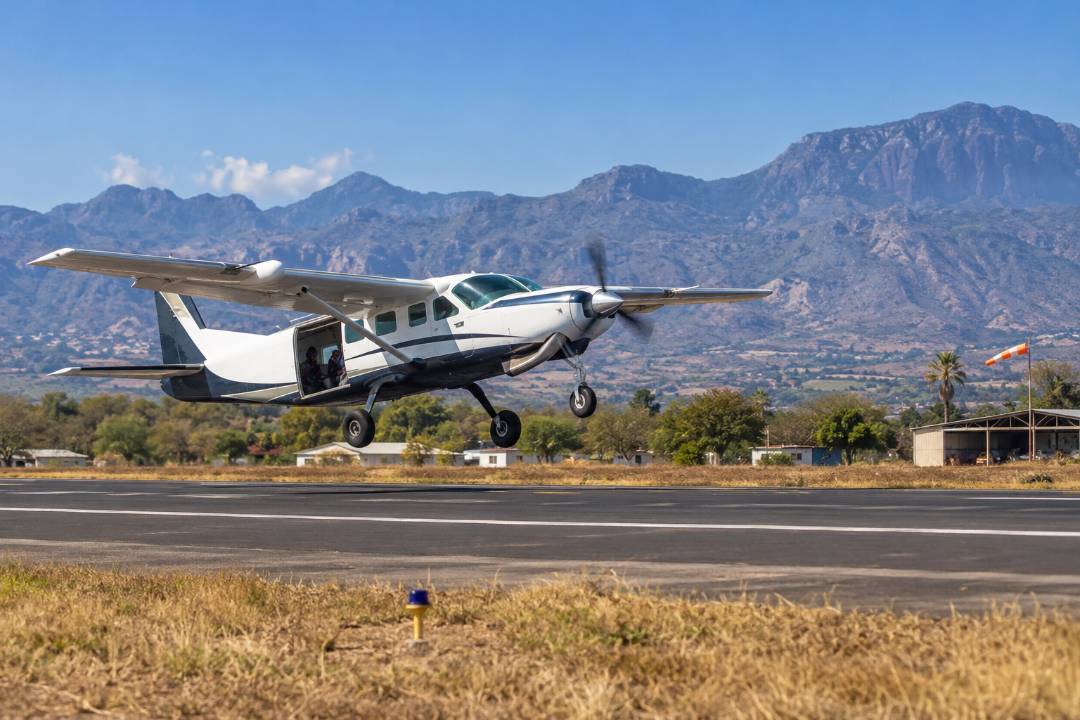
The day starts with registration, signing the liability waiver and a safety briefing. In Cuautla, for example, preparation before boarding takes about 20 minutes and covers the rules and practicing the body position for leaving the plane. Next you put on the harness and goggles, and the group boards the plane. In Playa del Carmen the plane carries up to three tandem pairs with their instructors, plus the pilot and, if booked, a camera operator.
The climb to jump altitude takes about 15-20 minutes. After the exit comes the freefall, which lasts between 30 and 90 seconds depending on the altitude and reaches about 200 km/h. Breathing isn’t a problem at that speed, and the feeling of vertigo almost disappears because there’s no nearby reference to the ground. The instructor opens the parachute at around 1,500 meters, and a calm descent of several minutes with panoramic views begins, ending in a soft landing in the marked area.
It’s best to set aside a full half day. At Skydive México the activity takes about 2-3 hours from arrival at the club, and the reservation time is the arrival time, not the jump time. The center works on a first-come, first-served basis, so anyone who arrives late may lose their turn to another group.
Requirements and Restrictions Before You Jump
Each center sets its own rules, but the requirements are very similar. Before booking, it’s worth checking these points:
- Minimum age. At Skydive México it is 8 years old, and minors need authorization from their parents or legal guardians.
- Weight. The usual maximum limit is 110 kg including clothes and shoes; Skydivemex in Playa del Carmen also requires a minimum of 35 kg. Some packages list lower limits, such as 90 kg, so it’s best to confirm when booking.
- Diving. Anyone who has gone scuba diving must wait 24 hours before jumping, a key rule in the Riviera Maya, where many travelers combine both activities.
- Alcohol and food. It’s recommended to avoid alcohol for 24 hours before and to eat a light meal at least 2 hours before the jump.
- Health. Pregnancy, heart problems, high blood pressure, recent surgery or fractures and epilepsy are usually reasons not to jump or to get a medical assessment first.
- Documents. You need a valid official ID and must sign the liability waiver on the day of the jump.
- Clothing. Comfortable sportswear and well-fitting sneakers; sandals are not suitable for landing.
A fear of heights is not usually an obstacle. According to Skydive México, vertigo appears when there is contact with the ground and a nearby reference, which doesn’t happen at the door of a plane several kilometers up. Certain disabilities don’t rule out a tandem jump either, although the instructor always makes the final decision.
How Much Skydiving Costs in Mexico
According to the rates published by the centers in 2026, a tandem jump in Mexico costs between $2,490 and $5,490 MXN in the center of the country and around $3,800 MXN in Puerto Escondido. The difference depends mainly on altitude: more feet means more seconds of freefall. In Tequesquitengo, going from 13,000 to 17,000 feet doubles the freefall from 30 to 60 seconds for $900 MXN more.
Photo and video extras are added to that price. At Skydive México, a handcam video filmed by the instructor costs $1,090 MXN, the photo and video package $1,390 MXN, and options with an outside camera operator reach $2,290-$2,790 MXN, with 4-6 minute edits and between 60 and 100 photos. In Playa del Carmen, each tandem pair needs its own camera operator to film the freefall and landing.
In the Riviera Maya, prices are usually quoted in dollars and vary by altitude and package, so it’s best to ask the center directly for a quote. Many operators take a deposit when you book, $500 MXN in Atlixco or $1,000 MXN in Puerto Escondido, and the rest is paid on the day of the jump. Some offer a promotional price for cash only, so it’s worth bringing pesos.
The Best Season for Skydiving in Mexico
The weather decides whether a jump goes ahead or is postponed. Centers cancel or delay jumps because of strong or gusty winds, rain, thunderstorms and low clouds that block the view of the landing area. That’s why the best time almost always coincides with the dry season.
In the center of the country, in Morelos and Puebla, the most stable months are November to March, with clear skies and predictable winds. During the rainy season, from May or June to October, mornings are usually better, because storms mostly build up in the afternoon. In the Mexican Caribbean, the ideal window is November to April, while June to October brings more rain and hurricane risk peaks from August to October. On the Oaxaca coast the pattern is similar: dry season from November to April and rain and cyclones between June and October.
If you’re traveling in the rainy season, you can book the jump for the first days of your trip and leave room to reschedule if the weather doesn’t cooperate. Most centers move the booking to another date when they cancel due to weather conditions.
Safety and How to Plan Jump Day
Modern skydiving is much safer than it looks. According to the USPA annual summary, from the United States Parachute Association, 3.88 million jumps were made in the US in 2024 with nine fatal accidents, one for every 430,000 jumps. It’s the first time since 1961, when records began, that the annual number has fallen below ten. In Mexico, the Mexican Parachuting Federation issues licenses, recognizes qualified instructors and promotes skydiving as a professional, organized sport.
When choosing a center, check that the tandem instructors are certified, that the equipment includes a reserve parachute, that the center clearly explains its weight limits and cancellation conditions, and that it publishes its prices and what they include. A reputable center doesn’t pressure you to jump in bad weather and leaves the final decision to the instructor.
The logistics of the day matter too. Centers ask you to arrive early, about 60 minutes before the jump in Playa del Carmen, and the whole activity takes several hours. For many travelers the jump falls on their arrival or departure day, with their suitcase still in tow. The Qeepl luggage storage service helps you find a verified location near airports, bus terminals and tourist areas from MX$73.90 per day per bag, so you can head to the airfield with only what you need: ID, comfortable clothes, sneakers and some cash for extras.